
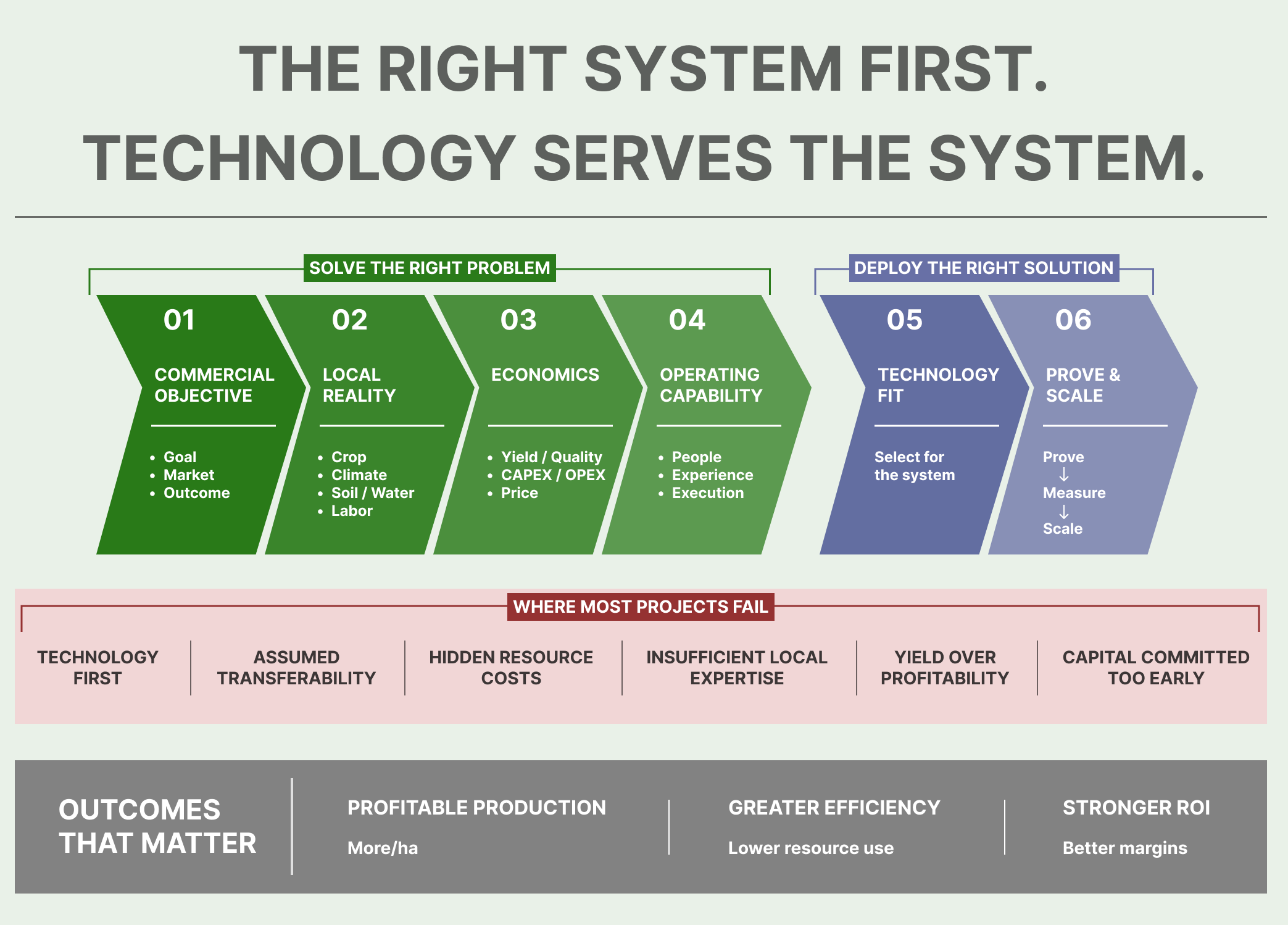
One of the most persistent mistakes in GCC agricultural development is assuming that better technology creates a better agricultural business.
It often does not.
A system can be technically excellent, proven internationally and capable of producing strong yields — yet still be the wrong commercial solution for the GCC.
Technical analysis asks whether the technology works.
Commercial performance asks whether the entire production system makes sense in the region.
That is a critical distinction.
The GCC Changes the Economics
Greenhouses illustrate the problem well.
Cooled greenhouses consume up to 32 times more energy than net houses. Meanwhile, water required for cooling can reach 3.5 times the irrigation requirement of the crop itself.
Trials have found that net-house systems can reduce production costs by 27% and increase net returns by 14% compared with conventional cooled greenhouses.
Nothing in those numbers suggests that a cooled greenhouse is technically deficient.
The question is whether additional control, yield or production periods justify the additional capital, energy, water and operating expense.
The objective should therefore be maximizing profitable production — not merely maximizing production.
Optimize the Viable Growing Window
A commercially rational approach is often to design production around periods when crops can be grown economically, rather than target year-round production.
During favourable months, open-field production can be an order of magnitude more cost-efficient than greenhouse production.
Net houses, greenhouses and other protected structures can extend the commercially viable growing window. Advanced technology adds value where additional productivity, quality or resource efficiency justifies the cost.
But technology has limits.
During the most extreme summer conditions, pausing production — rather than forcing it — may be more commercially rational.
Therefore, each asset must justify its cost through the crop, operating conditions and required outcome.
Technology-first projects risk confusing technical performance with commercial suitability. The objective should be to optimize commercial production within GCC realities, not use technology to overcome those realities at any cost.
‘Proven in Hot Climates’ Is Not Enough
Another common assumption is transferability.
A greenhouse that performs well under hot conditions in Spain, India or California may appear suited to the GCC. But environmental similarities can be misleading.
In southern Spain, hot days can still be followed by cooler nights. This allows systems to shut down and structures to dehumidify.
Under extreme GCC conditions, cooling may be required around the clock. Beyond the additional cost, constant cooling can keep humidity elevated and increase fungal and bacterial pressure.
GCC summer temperatures can reach 50°C, with temperatures above 45°C sustained for extended periods. This creates a difficult cultivation period lasting four to five months, roughly June to September.
Existing deployments demonstrate that evaporative cooling struggles to maintain target greenhouse conditions for substantial periods.
Therefore, proof in the local context — not technology alone — determines whether the system is appropriate.
Sometimes the Missing Technology Is Actually Experience
An example from regional experience makes this especially clear.
Experienced Dutch flower growers established greenhouse production in the GCC using world-class systems and flower-growing expertise.
The operation failed.
A grower with decades of local flower-growing experience ultimately took over and made it successful.
The infrastructure had not suddenly improved. What changed was the operating intelligence surrounding it.
The local operator understood variety selection, regional plant behaviour, localized agronomic practices and greenhouse adaptation. He also understood when to prepare inputs on-site rather than rely exclusively on premixed fertilizers.
The underlying lesson is valuable:
People and local operating expertise can matter more than the technology itself.
A blueberry specialist with GCC production experience may therefore be more valuable than a globally recognized expert who has never produced under local conditions.
Local experience captures variables that technical specifications and operating manuals cannot. Under GCC conditions, this expertise can determine commercial success.
Capital Should Follow Evidence
The practical implication is not to eliminate risk before investing. Agriculture will always involve uncertainty.
Instead, the objective is to avoid committing irreversible capital while critical assumptions remain untested.
Before significant CAPEX, a project should progressively establish:
- Agronomic viability: Can the crop reliably achieve the required yield and quality under local conditions?
- Resource viability: Are water, energy, labour and other inputs available at sustainable costs?
- Commercial viability: Is there a customer at a price that supports the required margins?
- Operational viability: Can the required expertise, maintenance and operating capability be secured locally?
- Technology fit: Does the selected system deliver the required outcome at an acceptable total cost?
- Repeatability: Can demonstrated performance be reproduced reliably enough to justify scale?
This creates a different approach to capital allocation.
Early expenditure buys evidence. Pilots validate assumptions. Initial commercial deployment establishes repeatability. Larger CAPEX follows once the economics and operating model have been sufficiently demonstrated.
That matters because agricultural infrastructure is difficult to unwind. Even technically successful infrastructure can become an expensive stranded asset if the assumptions surrounding it prove wrong.
Capital should therefore increase as uncertainty falls.
For GCC agricultural projects, that may be one of the most important distinctions between successfully deploying advanced technology and simply investing in it.